Signed in as:
filler@godaddy.com
Signed in as:
filler@godaddy.com
The risks that construction work poses to you and your family are often overlooked during the build process. It's easy to forget about when you're getting more and more excited about the changes you're about to make to your property. You think you've asked all the right questions, the budget and scope of work have been covered, and you can't wait to get into it but this is exactly where you need to slow down, take a step back, and see what you're really getting into.
Dust, particularly during a renovation project, poses a far greater risk to your health than most homeowners realise. The last thing you want when you return home at the end of the day, excited to see the progress that's been made, is to discover all of your belongings covered in a fine layer of dust. But the real question isn't just "how do I clean this up?" It's: what actually is this dust, and what is it doing to the people living in this house?
"Dust" isn't one thing. Depending on what's being cut, sanded, drilled or demolished, that fine layer settling over your kitchen bench could contain any combination of the following.
Silica. Cutting, grinding or drilling materials like concrete, tiles, bricks, sandstone, and engineered or natural stone benchtops releases crystalline silica dust, which can cause severe and irreversible health conditions including silicosis, lung cancer, COPD and kidney disease. The particles responsible are genuinely tiny crystalline silica, which is dust under 10 micrometres in diameter, and the smaller it is, the deeper it penetrates into the lungs. Critically, this respirable dust is invisible to the naked eye, by the time you can see dust on a surface, you've likely already been breathing it in.
This isn't a fringe concern. As of 1 September 2024, Australia introduced significantly strengthened regulations for managing crystalline silica exposure, expanding protections to over workers. Builders are now legally required to assess whether silica-generating work is high-risk, and where it is, undertake air monitoring, provide health monitoring for affected workers, and train workers on the risks before any cutting or grinding begins.
Asbestos. If your home was built before 2004 and especially before 1990 there's a real chance asbestos-containing materials are present. Homes built from the 1950s to the 1990s have a high likelihood of containing asbestos, with that likelihood decreasing from 1990 to 2003, and it's estimated that roughly one third of Australian homes still contain some form of asbestos today. It was used extensively in bathroom, laundry and kitchen construction specifically because of its resistance to heat, water and decay which means the very rooms most homeowners want to renovate are often the rooms most likely to contain it.
The legal position here is clear: under the Work Health and Safety Regulation, a builder must not carry out demolition or refurbishment work on a structure built before 2004 unless that structure has first been assessed for asbestos. If your builder isn't asking about the age of your home or raising asbestos before work starts, that's worth questioning. And the risk isn't theoretical. There is now an emerging "third wave" of asbestos-related disease victims: people who were never exposed occupationally, but through home renovations. Demolition can be fun, but also deadly if you don’t know what you’re doing.
Mould. Less regulated, but no less relevant. Opening up wet areas, removing old wall linings, or disturbing long-closed cavities can release mould spores that have been trapped for years, which is a genuine concern for anyone in the household with respiratory sensitivities, especially kids.
None of this means every renovation is dangerous. It means dust needs to be controlled at the source, not cleaned up after the fact because once airborne, fine particles travel far further through a home than most people expect, settling into soft furnishings, ductwork, and rooms nowhere near the actual work site.
This is exactly why, at B.E Bespoke, dust management isn't an afterthought tacked onto the end of a job it's built into how we plan and run every project from day one.
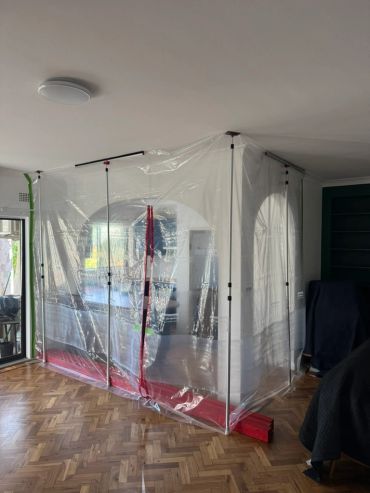
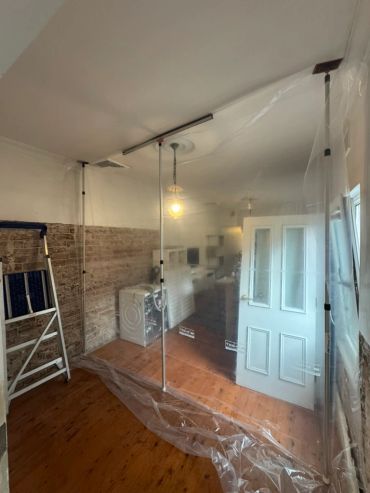
1. Isolate the work area. We physically separate the construction zone from the rest of your home; dust walls to seal off a kitchen during a renovation, or a dust door to contain a bathroom so the mess, and the airborne particles that come with it, stay where the work is happening rather than migrating through your living spaces.
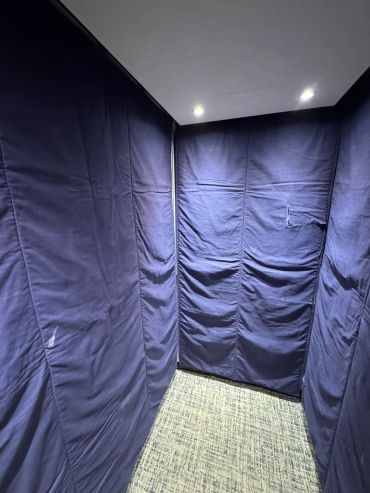
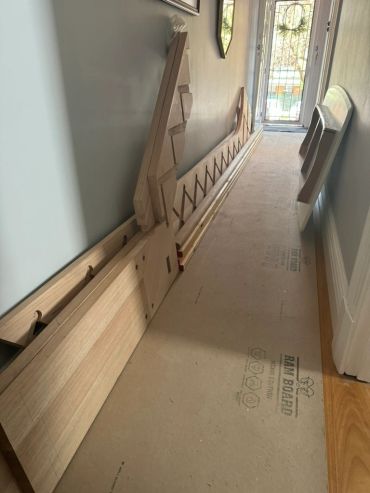
2. Protect what's being retained. Heavy-duty floor protection (such as Ramboard) on hard surfaces, temporary adhesive carpet protection on soft flooring, and edge protection over door jambs in high-traffic routes — all installed before a single tool is switched on, so the rest of your home comes through the build intact.
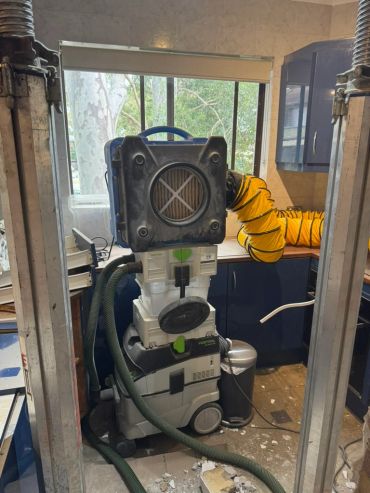
3. Extract dust at the source. Almost every modern power tool that generates dust can be fitted with an extractor, and we run multiple extractors on our tools to catch dust at the source which is standard practice on all our dust generating tools, no exceptions. This matters more than people realise: current silica regulations specifically call for on-tool extraction connected to vacuum systems with HEPA filtration as a primary control measure, capturing dust before it becomes airborne is always more effective than trying to clean it up afterwards.
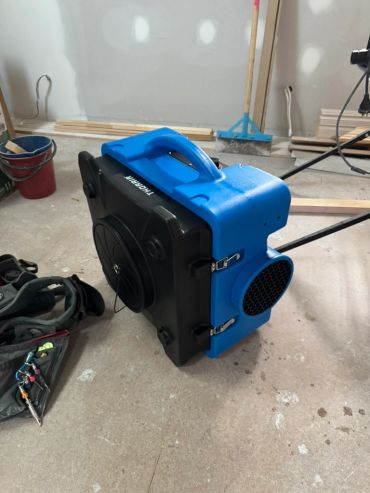
4. Scrub the air. We deploy industrial air scrubbers. These are filtration units capable of pulling out the vast majority of airborne particles so the air inside your home stays as clean as, or cleaner than, it was before work began. It's one of the most effective tools available for protecting everyone on site, tradespeople and homeowners alike.
5. Identify before we disturb. For any home built before 2004, asbestos is on the table as a question before it's on the table as a problem. Identifying risk materials before they're cut, sanded or removed is what keeps a renovation a renovation, rather than an exposure incident.
A builder that is concerned about safety won't be put off by these questions.
If the answers feel vague, or the plan only covers the budget and the finish not the air your family is breathing during the build that's worth pausing on.
There is nothing more valuable than your family's health, certainly not the home you're renovating to improve their quality of life. The safety measures available to builders today are extensive, well understood, and backed by regulation and legislation. They need to be used, not treated as optional extras.
Before work starts, ask yourself: do I have a safe builder? Do I have a clean builder? How does my builder plan to protect my family?
At B.E Bespoke, those questions aren't an inconvenience, they're the starting point of every project we take on.